Choosing the Right Sunscreen for Umrah and Hajj: SPF50 PA+++ Explained
Learn how to choose sunscreen for Umrah and Hajj. Covers SPF50, UVA/UVB, reapplication, hot weather, sensitive skin, ihram concerns, wudhu-friendly texture, and Rehla Daily UV Defense SPF50.
Everything Pilgrims Need to Know
Sunscreen for Umrah and Hajj is important because Malaysian pilgrims may spend long periods walking, waiting, and moving outdoors under strong sun exposure.
The best sunscreen should be SPF50, ihram friendly, broad-spectrum, lightweight, non-sticky, non-greasy, fragrance-free, alcohol-free, and suitable for sensitive skin.
For pilgrimage use, sunscreen must do more than protect against UV rays. It should also feel comfortable during wudhu, avoid fragrance-related concern during ihram, and be easy to reapply during long travel and worship days.
Rehla Daily UV Defense SPF50 PA+++ fits this need because it is positioned for Umrah and Hajj use, with SPF50 PA+++, UVA/UVB and Blue Ray protection, a water-based with lightweight texture, non-sticky finish, non-greasy feel, no white cast claim, dan alcohol-free and fragrance-free claims.
Why Sunscreen Matters During Umrah and Hajj
Umrah and Hajj involve more outdoor movement than many first-time pilgrims expect. A pilgrim may walk between hotels, buses, mosque areas, open walkways, waiting zones, and outdoor gathering points several times a day.
Sun exposure can happen even when the main ritual feels short. The exposure builds up across the day.
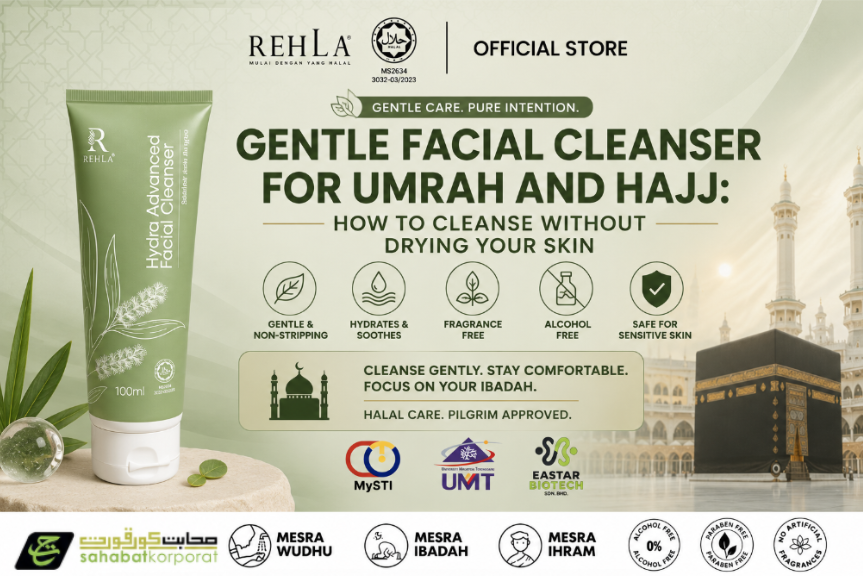
For Malaysian pilgrims, the skin is also moving from humid Malaysia into a hotter and drier environment. This climate shift can make the skin feel more sensitive, especially when combined with sweat, dust, repeated cleansing (where a gentle facial cleanser is essential), air-conditioning, and long walking hours.
Sunscreen helps reduce UV exposure on commonly exposed areas such as:
- Face
- Neck
- Ears
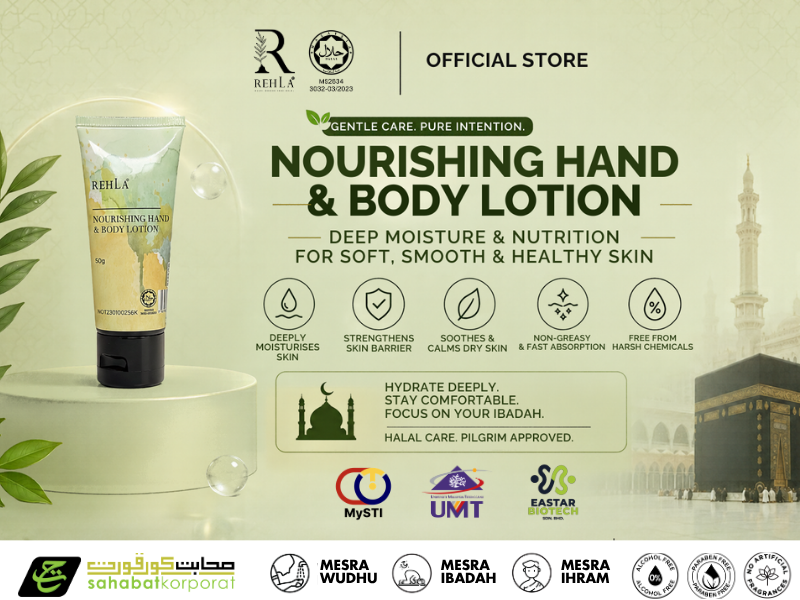
- Hands (using a deeply absorbing hand & body lotion provides added relief)
- Forearms, if exposed
- Other exposed areas depending on clothing and ritual context
For pilgrims, sunscreen is not primarily about beauty or cosmetic appearance. It is about protecting the skin from prolonged sun exposure, reducing the risk of sunburn, minimising discomfort caused by heat and UV rays, and helping the skin remain comfortable throughout the pilgrimage. By protecting the skin from unnecessary irritation, pilgrims can focus more fully on their ibadah without the distraction of painful, sun-damaged skin.
What Makes Sunscreen Different for Pilgrims?
A normal sunscreen only needs to protect the skin from UV rays. A sunscreen for Umrah and Hajj needs to do more than that—it should fit the realities of the pilgrimage journey.
Pilgrims spend long hours outdoors under intense sun exposure, walk significant distances, perform wudhu multiple times a day, and may need to reapply sunscreen regularly. As a result, the ideal sunscreen should provide high SPF and broad-spectrum protection while remaining practical for worship and daily pilgrimage activities.
| Sunscreen Requirement | Why It Matters During Umrah and Hajj |
|---|---|
| SPF50, PA+++ (Protection Grade of UVA) | Gives strong practical protection for outdoor exposure, High UVA protection (blocks up to 90% of UVA rays) |
| Broad-spectrum protection | Covers both UVA (long-wave sun rays that penetrate deep into the skin) and UVB (rays that cause sunburn) concerns |
| Ihram-friendly | Preferably fragrance-free to minimise concerns during ihram |
| Wudhu-friendly | With a lightweight texture that is easy to remove with water and reapply |
| Non-water-resistant | Does not leave a heavy barrier on the skin |
| Lightweight texture | Feels more comfortable in hot weather |
| Non-sticky finish | Reduces discomfort from sweat and dust |
| Non-greasy feel | Feels cleaner before prayer and wudhu |
| Fragrance-free claim | Reduces ihram-related concern |
| Alcohol-free claim | Appeals to halal-conscious and sensitive-skin users |
| Sensitive-skin suitability | Useful when skin is stressed by heat, sweat, and repeated washing |
| Travel-friendly size | Easier to carry for reapplication |
This is the core difference: the best sunscreen for pilgrimage is not just the one with the highest SPF. It is the one a pilgrim can use consistently without discomfort or doubt.
Understanding SPF50 and UV / Blue Rays
What Does SPF50 Mean?
SPF means Sun Protection Factor. It mainly refers to protection against UVA/UVB rays, which are strongly linked to sunburn.
SPF50 is a strong practical choice for Umrah and Hajj because pilgrims may face repeated outdoor exposure throughout the day. A successful pilgrimage requires physical resilience, and safeguarding your skin from the intense desert heat is a crucial part of that preparation. However, SPF50 does not mean the skin is protected all day after one application.
Sunscreen protection can reduce when the product is:
- Sweated off
- Washed off
- Wiped away
- After washing face / wuduk
- Rubbed by towel, tissue, mask, scarf, or hand
- Applied too thinly
- Not reapplied after long outdoor exposure
So the key is not only choosing SPF50. The key is applying enough and reapplying when needed.
UVA, UVB, Blue Ray and PA+++: What Pilgrims Should Know
A good sunscreen for Umrah and Hajj should protect against both UVA, UVB and Blue Rays.
| Term | Meaning | Why It Matters |
|---|---|---|
| UVB | Rays linked to sunburn | Important for preventing painful redness and burning |
| UVA | Rays linked to tanning, pigmentation, and deeper skin stress | Important for long outdoor exposure |
| Blue Ray | High-energy visible (HEV) blue light that comes from sun, smartphones, tablet and screens | Protect skin from oxidative stress caused by prolonged exposure to blue light |
| Broad-spectrum | Protection against both UVA and UVB | Better overall protection |
| PA+++ | A rating commonly used to indicate UVA protection | Useful for pigmentation and tanning concerns |
Rehla Daily UV Defense SPF50 is positioned as SPF50 PA+++ protect agains UVA, UVB and Blue Rays, which makes it relevant for their comfort and high performance protection, shielding pilgrims from immediate sunburns and long term UVA-related protection during travel. It also contains a 5X ceramide complex that helps support and strengthen the skin barrier while protecting against UV rays.
Why Texture Matters More During Pilgrimage
The best sunscreen is the one the pilgrim will actually apply and reapply and handy to use.
A sunscreen may have strong protection on paper, but if it feels sticky, greasy, thick, or uncomfortable with a thick occlusive layer on skin, the user may avoid it. During Umrah and Hajj, this problem becomes more serious because the skin is already dealing with heat, sweat, dust, and repeated wudhu.
For pilgrimage use, texture should be:
| Texture Feature | Practical Benefit |
|---|---|
| Lightweight | More comfortable in hot weather |
| Non-sticky | Less dust and sweat discomfort |
| Non-greasy | Feels cleaner before prayer |
| Fast-spreading | Easier to apply quickly before leaving the hotel |
| No white cast | More comfortable for daily use |
| Comfortable around the eyes | Reduces stinging during sweat or reapplication |
| Easy to cleanse | Reduces worry before wudhu by simple cleansing using water without any soap |
Rehla describes its Daily UV Defense SPF50 PA+++ is designed with the practical needs of pilgrims in mind. Its as water-based, lightweight, non-sticky, non-greasy texture makes it comfortable to wear throughout the day, even in hot weather and during long periods of outdoor activity. The formula also leaves no white cast, allowing it to blend easily into the skin without affecting appearance.
These features are particularly beneficial for Malaysian pilgrims who perform wudhu multiple times a day and may need to reapply sunscreen regularly. A lightweight and easy-to-cleanse sunscreen can fit more naturally into a worship routine, helping pilgrims stay protected from the sun while maintaining comfort and convenience throughout their Umrah and Hajj journey.
Can Sunscreen Be Used During Ihram?
Many pilgrims are cautious with skincare during ihram because of halal ingredients and fragrance-related restrictions. This is why sunscreen for Umrah and Hajj should ideally be ihram friendly that is fragrance-free.
The concern is not sunscreen itself. The concern is whether the product contains perfume, scent, essential oils fragrance ingredients or not halal certified that create doubt during ihram.
For safer product selection, Malaysian pilgrims should look for:
- Halal certified
- Fragrance-free claim
- Alcohol-free claim
- No perfume claim
- Clear product description for pilgrimage use
There is also a difference between fragrance-free and unscented.
Fragrance-free usually means no artificial fragrance has been intentionally added. Unscented may mean the product has no obvious smell, but it may still contain masking fragrance.
For ihram-conscious pilgrims, fragrance-free is usually the clearer and safer label to look for.
If a pilgrim is unsure about a specific sunscreen, the best step is to ask a qualified ustaz, ustazah, mutawif, or official religious guidance source.
Can Sunscreen Affect Wudhu?
Some pilgrims worry that sunscreen may create a layer that affects wudhu. This concern usually becomes stronger when the sunscreen feels thick, waxy, waterproof, or difficult to remove.
For this reason, many Muslim consumers prefer lightweight, water-based sunscreens that absorb well into the skin and do not leave a heavy residue. Sunscreens that are easy to rinse off and reapply can provide greater comfort and peace of mind for those who perform wudhu multiple times throughout the day.
A more practical choice is a sunscreen that feels:
- Lightweight
- Non-greasy
- Non-waxy and do not leave occlusive layer on skin
- Easy to spread
- Comfortable after cleansing
- Not waterproof for normal daily use
- Clear in product claims
A sunscreen that feels heavy may create discomfort and doubt. A sunscreen that feels light and easy to cleanse is usually easier to include in a repeated wudhu routine.
This is why texture matters not only for comfort, but also for peace of mind.
If unsure whether a specific sunscreen affects wudhu validity, pilgrims should seek qualified religious guidance.
How to Apply Sunscreen During Umrah and Hajj
A sunscreen routine for pilgrimage should be simple. Pilgrims already have enough to manage during travel and worship.
Morning Application Routine
Apply sunscreen before leaving the hotel or accommodation.
Cleanse face with facial cleanser if needed
Apply lightweight moisturiser if dry
Apply sunscreen evenly on face and neck
Let it settle before going outdoors
Carry sunscreen for reapplication
Focus on areas that are commonly missed:
- Ears
- Neck
- Jawline
- Hairline
- Back of hands
- Sides of the face
- Around the nose
How Often Should Pilgrims Reapply Sunscreen?
Sunscreen should be reapplied because protection reduces during the day.
Reapply when:
- You sweat heavily
- You wipe your face (using specialized face hydra wipes keeps you dry and hydrated)
- You perform wudhu and the sunscreen is removed
- You wash your face
- You spend long periods outdoors
- You move between hotels, buses, mosque areas, and open walkways (staying refreshed with halal bath wipes during transits is a great practice)
- Your skin feels exposed after rubbing or towel drying
Rehla’s Daily UV Defense SPF50 PA+++ page recommends reapplication every 2 to 3 hours. For intense outdoor exposure, heavy sweating, or frequent wiping, pilgrims may need to reapply sooner based on product instructions and skin condition. Regular reapplication is especially important during long outdoor periods, as sunscreen protection gradually decreases with sweat, friction, and normal daily activities.
SPF50 Sunscreen Routine for Pilgrims
A practical sunscreen routine should be easy to repeat.
| Time | What to Do | Why It Helps |
|---|---|---|
| Before leaving hotel | Apply SPF50 sunscreen after applying the moisturiser | Prepares skin before sun exposure |
| Before long outdoor movement | Reapply if the previous layer has worn off after 2-3 hours | Helps maintains protection |
| After sweating or wiping | Reapply on exposed areas | Restores coverage |
| After wudhu if removed | Reapply before going outdoors again | Keeps protection consistent |
| At night | Cleanse sunscreen properly (washing your skin gently and using a splash of premium shower oil after helps lock in moisture) | Prevents buildup and discomfort |
Mineral, Chemical, or Hybrid Sunscreen?
Pilgrims often ask whether mineral sunscreen is better than chemical sunscreen. The answer depends on the full formulation.
| Sunscreen Type | Common Features | What Pilgrims Should Consider |
|---|---|---|
| Mineral sunscreen | Uses filters such as zinc oxide or titanium dioxide | Often suitable for sensitive skin, but may feel thicker or leave white cast |
| Chemical sunscreen | Uses organic UV filters | Often lighter, but may sting some eyes or sensitive skin (similarly to using a mild hair shampoo, gentle formulas avoid irritation) |
| Hybrid sunscreen | Combines mineral and chemical filters | Can balance protection and texture, depending on formula |
For Umrah and Hajj, the most important point is not only the filter type. Pilgrims should look at the full user experience:
- Is it SPF50?
- Is it broad-spectrum?
- Is it halal certified?
- Is it fragrance-free?
- Is it alcohol-free?
- Is it lightweight?
- Is it non-greasy?
- Is it comfortable after sweating?
- Is it wuduk friendly?
- Is it easy to reapply?
- Is it suitable for sensitive skin?
A sunscreen that is technically strong but uncomfortable may not be used consistently. A comfortable sunscreen with strong protection is more practical and a reliable companion for pilgrimage.
Sunscreen for Sensitive Skin During Umrah and Hajj
Sensitive skin can become more reactive during pilgrimage because of heat, sweat, dust, air-conditioning, repeated cleansing, and long travel days.
A sunscreen for sensitive skin should be:
- Gentle
- Non-sticky
- Non-greasy
- Fragrance-free
- Alcohol-free
- Comfortable around the eyes
- Suitable for daily reapplication
Rehla Daily UV Defense SPF50 PA+++ contains ingredients such as Squalane, Allantoin, Bromelain, and Melaleuca Cajuputi Extract, which help support skin comfort while providing daily sun protection. The sunscreen is also positioned as suitable for sensitive skin, making it a practical option for pilgrims who may experience skin dryness, heat exposure, and environmental stress during Umrah and Hajj.
Regardless of the sunscreen chosen, pilgrims are encouraged to test the product several weeks before departure. Umrah and Hajj are not the ideal time to experiment with new skincare products. Testing sunscreen in Malaysia allows pilgrims to identify any sensitivity, irritation, or discomfort early, helping ensure a smoother and more comfortable pilgrimage experience when they arrive in Makkah or Madinah.
Before departure, pilgrims should test sunscreen in Malaysia. Do not use a new sunscreen for the first time in Makkah or Madinah to avoid any irritation during pilgrimage.
Test for:
- Eye stinging
- Itching
- Redness
- Breakouts
- Greasy feel
- Sticky finish
- White cast
- Pilling under moisturiser
- Comfort after sweating
Why Rehla Daily UV Defense SPF50 is Suitable for Umrah and Hajj
This is where Rehla Daily UV Defense SPF50 PA+++ becomes a practical companion for pilgrims. As part of Rehla's Umrah and Hajj skincare range (we also recommend carrying a complete exclusive bodycare set and the complete exclusive skincare set for comprehensive protection), it is designed to address the realities of pilgrimage, where long hours under the sun, frequent movement, and repeated wudhu are part of daily life. Its lightweight, water-based formula helps provide high sun protection without feeling heavy, greasy, or uncomfortable, making it easier for pilgrims to stay protected while focusing on their worship and journey.
| Rehla Sunscreen Attribute | Relevance for Pilgrims |
|---|---|
| SPF50 PA+++ | Supports strong UV protection |
| UVA, UVB and Blue Ray protection | Helps with sunburn, tanning, and pigmentation concerns |
| Water-based texture | More comfortable in hot weather and easily to remove during wuduk |
| Lightweight finish | Easier to wear daily |
| Non-sticky | Reduces discomfort from sweat and dust |
| Non-greasy | Feels cleaner before prayer |
| No white cast | More comfortable for regular use |
| Alcohol-free | Useful for halal-conscious and sensitive-skin buyers |
| Fragrance-free | Important for ihram-conscious pilgrims |
| 30ml and 50ml options | Practical for travel and reapplication |
REHLA Daily UV Defense SPF50
Water-Based, Lightweight Formula
Get Your Ultimate Travel Sunscreen
Specially developed to stand up to the extreme desert climate of Makkah and Madinah, REHLA Daily UV Defense SPF50 PA+++ provides long-lasting broad-spectrum shield without blocking wudhu or breaking ihram rules.
Common Sunscreen Mistakes Pilgrims Should Avoid
Mistake 1: Applying Too Little
A very thin layer may not provide the expected SPF protection. Apply enough to cover the face, neck, ears, and other exposed areas evenly.
Mistake 2: Applying Only Once
Sunscreen wears down with sweat, rubbing, wiping, washing, and time outdoors. Reapplication is part of proper sunscreen use.
Mistake 3: Skipping on Cloudy Days
Cloudy or dusty weather does not mean there is no UV exposure. Pilgrims can still receive UV rays while walking or waiting outdoors.
Mistake 4: Forgetting Key Areas
Many people apply sunscreen only on the cheeks and forehead. Pilgrims should also protect the ears, neck, sides of the face, and hands.
Mistake 5: Choosing Heavy Formulas
If the sunscreen feels sticky or greasy, you may stop using it. Texture affects consistency, especially in hot weather.
Mistake 6: Not Testing Before Travel
A sunscreen may look suitable on the label but feel uncomfortable on your skin. Test it before travel to ensure it’s practical, reliable and avoid irritation during pilgrimage in order to provide you with a worry free spiritual journey.
Final Advice
Sunscreen should be part of every practical Umrah and Hajj preparation plan.
For Malaysian pilgrims, choose a sunscreen that is SPF50 PA+++, halal certified broad-spectrum, lightweight, non-sticky, non-greasy, ihram friendly which means (fragrance-free, alcohol-free), and suitable for sensitive skin.
Apply it indoors before outdoor exposure. Reapply it when sweating, wiping, washing, or spending long periods outdoors. Choose a texture that feels comfortable enough to use every day.
The best sunscreen for pilgrimage is not only the one with strong protection. It is the one that protects your skin health so you can fulfill your rites with complete peace of mind and physical ease. The best sunscreen for Umrah and Hajj is not simply the one with the strongest SPF. It is the one that protects the skin effectively while fitting seamlessly into the pilgrimage journey. By helping to prevent sunburn, minimise skin discomfort, and support overall skin health, the right sunscreen allows pilgrims to focus on their ibadah with greater comfort, confidence, and peace of mind throughout their sacred journey.
Frequently Asked Questions
Do I need sunscreen for Umrah?
Do I need sunscreen for Hajj?
Yes. Hajj can involve longer outdoor movement, heat, walking, waiting, and crowding. Sunscreen is especially useful for exposed areas such as the face, neck, ears, and hands. Climate in Saudi Arabia is intensely hot and sunny, unprotected skin can quickly lead to severe sunburns, heat exhaustion, and long-term skin damage.
Is SPF50 enough for Umrah and Hajj?
How often should I reapply sunscreen during Umrah or Hajj?
Can I use sunscreen during ihram?
However, many pilgrims prefer to choose a fragrance-free and alcohol-free sunscreen during ihram to avoid concerns regarding scented products. A lightweight, non-greasy sunscreen that is easy to apply, cleanse, and reapply is often the most practical choice for the pilgrimage journey.
Can sunscreen affect wudhu?
Should I choose fragrance-free or unscented sunscreen?
Should I apply sunscreen before or after moisturiser?
What type of sunscreen is best for Malaysian pilgrims?
Is mineral sunscreen better for Umrah and Hajj?
Equip Your Skincare & Bodycare Kit
Don't guess what items to carry. Select and packs your sacred essentials from the trusted, halal-conscious range built around the actual journey realities.